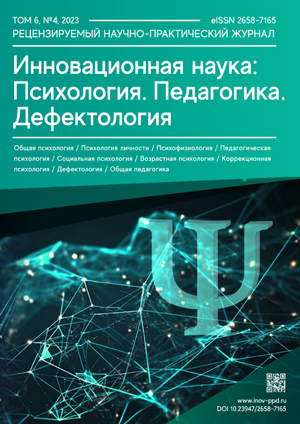
Peer-reviewed scientific journal “Innovative science: psychology, pedagogy, defectology”.
Founder and Publisher: Federal State Budgetary Educational Institution of Higher Education "Don State Technical University", Rostov-on-Don, Russian Federation, https://donstu.ru/
ISSN (online) 2658-7165
Year of foundation: 2017.
Frequency: 6 issues per year.
Distribution: Russian Federation.
The journal Innovative science: psychology, pedagogy, defectology accepts for publication original articles, studies, review papers, that have not been previously published.
Website: https://www.inov-ppd.ru
Editor-in-Chief: Irina V. Abakumova, Dr. Sci. (Psychology), Professor (Rostov-on-Don, Russian Federation).
Languages: Russian, English
Key characteristics: indexing, peer-reviewing.
Licensing history:
The Journal uses International Creative Commons Attribution 4.0 (CC BY) license.
Current issue
GENERAL PEDAGOGY, HISTORY OF PEDAGOGY AND EDUCATION
Introduction. This study describes the psychophysiological parameters of children with hearing impairments who master badminton. The program of physical culture and recreation classes in the badminton section, aimed at adaptation and harmonious physical development of hearing-impaired young athletes, is presented and tested.
Objective. To investigate the psychophysical state of hard-of-hearing badminton players, assess the impact of badminton on their motor and visual functions, and create a training system for children with hearing impairment. To achieve this Objective, the following tasks are formulated. To investigate the psychophysiological characteristics of children with hearing impairments involved in badminton. To analyze how systematic badminton training affects psychoemotional wellbeing and interest in sports activities. Form a badminton training methodology for children with hearing impairments.
Materials and Methods. As part of the two-stage study, a review of scientific and methodological sources was carried out and an experimental program was created that provided for testing participants and pedagogical observation. Based on the collected and processed data, it was possible to create a system of badminton training sessions for children with hearing impairments. An essential component of the adaptation process was the introduction of joint training: children with hearing impairments are engaged together with hearing peers, which contributes to their social adaptation.
Results. A set of pedagogical tools has been developed to increase the involvement and interest of children with hearing impairments and their hearing peers in joint badminton training. The main psychophysiological features of children with hearing impairment that affect the development of badminton techniques (including features of visual-motor coordination, spatial perception, and the ability to switch attention) are revealed.
Discussion. The analysis of intermediate and final indicators showed positive dynamics in the development of key motor qualities of program participants. The results of the study indicate the expediency of further application and scaling of adapted badminton techniques in working with children with hearing disorders. The combination of data obtained during the experiment and testing allows us to recognize the developed methodology as suitable for use in working with students with hearing disorders. The practical value of the study lies in the possibility of using the proposed methodology in the work of sports schools and rehabilitation centers specializing in classes with children with hearing impairment.
Introduction. The article analyzes methodological techniques for using graphic illustration and a system of reference signals in lectures and practical classes in the disciplines of “Business Communication”, “Document Linguistics”. There is a need to optimize the solution of some pedagogical information technology problems related to the methods of transmitting and receiving educational information in the educational field of socio-humanitarian disciplines.
Objective. Expanding the boundaries of the presentation of educational content, allowing students to see the main thing in it, understand the essence of many phenomena at the same time and then quickly navigate the dynamic scientific and information flow.
Materials and Methods. We used complementary general scientific theoretical methods for analyzing techniques and methods of reflecting the educational and informative paradigm with the inclusion of illustrative and graphic aspects of reproducing incoming and outgoing information, as well as a qualitative method for studying individual features of reference “scripts” for more effective functioning of the educational process.
Results. For students, systems of reference “scripts” have been developed and methodological techniques for their implementation in the process of studying the disciplines “Business Communication” and “Document Linguistics” have been tested. Depending on the content of a particular discipline and the level of training of students, a comparative analysis of the results of mastering the presented educational material was carried out with the inclusion of illustrative-graphic and support-signal accompaniment and without the use of visual and structural staples (the traditional lecture method of submitting and receiving educational information for socio-humanitarian disciplines). Based on the obtained data (based on the results of the current and intermediate certification of students), a conclusion is made about the expediency of using the considered techniques in solving educational and practical problems in the course of teaching these disciplines.
Discussion. Investigating the relationship of speech-thinking components with the proposed resources for visual and “script” perception of the educational topic, we believe that the process of learning information by students will be more effective with a gradual transition from visual-figurative thinking to abstract-logical. Methodological recommendations are given to teachers on the formation of support and didactic material for lectures and practical classes with the use of illustrative and signal visibility tools in accordance with the competence approach in education.
Introduction. Scientific labour management was one of the domestic management concepts introduced in the early years of Soviet authority as a tool for improving production efficiency. For the full implementation of this concept, it was crucial to change the consciousness of workers, including through psychotechnical methods.
Objective. Examine the regional experience of implementing a scientific labour management department at the Don Polytechnic Institute in the mid-1920s, within the context of modern approaches to reforming engineering education and taking into account national educational traditions.
Materials and Methods. The source material for this study consists of archival documents stored in the State Archives of the Rostov Region. General scientific methods as well as specialized scientific methods, including comparative historical and retrospective analysis, were used.
Results. Teaching future engineers and technicians the fundamentals of anatomy and physiology, as well as the characteristics of muscle rhythms, was considered the optimal way to develop a “new type” of worker. Taking into account the unfavorable foreign policy context, Soviet Russian enterprises needed effective personnel for the country’s future industrialization. The Scientific Organization of Workers concept was considered the optimal way to increase worker productivity by optimizing their activities. However, this organization, like many other initiatives in the 1930s, fell into disuse due to the centralization of the country’s educational system.
Discussion. This study contributes to the study of the history of psychological science and pedagogy in southern Russia in the 1920s. Previously unused archival sources on the history of labor psychology and industrial psychology are introduced into scholarly circulation for the first time. This study contributes to the biography of Nikolai Nikolaevich Dyakov, a Don scientist who, as a professor (1920), initiated the creation of the Scientific Labour Organization Department at the Don Polytechnic Institute and was the first head of the Machine Parts Department at the Rostov Institute of Agricultural Machinery.
GENERAL PSYCHOLOGY, PERSONALITY PSYCHOLOGY, HISTORY OF PSYCHOLOGY
Introduction. The relevance of the topic is determined by the high influence of self-attitude, in particular, internal conflict, on the behavior of the individual and, as a result, on the quality of life and subjective well-being.
Objective. To study the features of the structure of psychological defenses and self-expression in women as predictors and consequences of internal conflict.
Materials and Methods. To collect empirical data, we used the “Internal conflict” scale, which is part of S. R. Pantileev’s “MIS”, “Methodology for diagnosing the structure and strength of psychological defense” and the questionnaire “Strategies of self-expression”. The results were processed using Mann-Whitney U-test, correlation analysis, and linear regression.
Results. The study involved 94 women aged 18 to 43 years. The respondents were divided into two groups: 1) women with a low level of internal conflict (n = 54), 2) women with a high level of internal conflict (n = 40). Statistically significant differences were confirmed on the scales of “Weakness Demonstrations / pleading”, “Impression Tracking”, “Displacement”, “Regression” and “Bias”. The average values of all parameters are higher in the group of women with a high level of internal conflict. The core of the relationships between the parameters of defense mechanisms and self-expression in group 1 is built around the indicators “Regression”, “Demonstration of weakness/ pleading” and “Tracking impressions”. In Group 2, relationships are built around the parameters “Behavior Variability”, “Sublimation”, “Impression Tracking” and “Projection”. Psychological defenses “Displacement”, “Regression” and “Displacement” are predictors of internal conflict. At the same time, internal conflict affects the expression of the parameters of self-expression “Demonstration of weakness / plea” and “Tracking impressions”.
Discussion. Internal conflict manifested itself as an intermediate variable: on the one hand, it is determined by various types of psychological defenses (regression, displacement, displacement), and on the other hand, it itself acts as a factor of individual behavior (demonstration of weakness, tracking impressions).
Introduction. In modern conditions of life, success becomes a priority value both at the individual and social level. Mobility of life now imposes special requirements on the severity of subjective predictors of success. In the system of determining success in the context of mobility, first of all, it is necessary to consider those that provide non-situational support, sustainability and effectiveness. Master’s degree studies are considered as a period of professional mobility for people with a different profile of education, which implies the creation of certain conditions for success and actualization of achievement motivation in new conditions. All this confirms the relevance of studying the psychological factors of personal success in the context of mobility. The novelty of this study is to identify the content features of psychological factors of success of undergraduates’ personality in a situation of mobility.
Objective. To study the peculiarities of psychological factors of personal success in the conditions of mobility.
Materials and Methods. To assess the severity of success determination factors, we used the test of “Life-meaning orientations” by D. A. Leontiev (modified “PIL” by D. Crumbo and L. Makholik); the test-questionnaire “Need for Achievement” (Yu. M. Orlov, V. I. Shurkin, L. P. Orlova); and the “Resilience Test” by S. Muddy (adapted by D. A. Leontiev E. I. Rasskazova); and NCETA “Determinants of success in mobility” (T. N. Shcherbakova). The results were processed using Spearman’s rank correlation coefficient and the Mann-Whitney criterion (U).
Results. The study involved 120 master’s students of the humanities studying at DSTU (Rostov-on-Don), who have a higher education of a different profile, which makes them participants in a situation of professional mobility. The content of undergraduates ‘ presentations clearly shows the determining factors of individual success in conditions of high mobility, the resources and risks of this context of activity implementation. Among the determinants of personal success in a situation of mobility, life-meaning orientations, the need for achievement and resilience are highlighted. It is shown that there is a connection between resilience and scales of life-meaning orientations.
Discussion. The data obtained as a result of the study can be used in the system of psychological support for the formation of success of undergraduates in a situation of mobility. The results of the study can also serve as certain guidelines in modeling the acmeological environment of a university. The identified resources and risks in the content of psychological factors of individual success in a situation of mobility can become the basic points of the model of development of success of undergraduates in the period of professional mobility.
Introduction. Student age is characterized by high academic loads and high uncertainty of educational conditions, which provokes the development of chronic stress and reduces the overall psychological well-being of students. The key role in successfully overcoming these difficulties is played by the internal resources of the individual, among which academic resistance, conscious self-regulation and semantic coping are particularly distinguished. However, the exact mechanisms of their interrelationships under stress conditions remain insufficiently studied.
Objective. Identification of the nature and direction of interrelations between indicators of perceived stress, academic resilience, semantic coping and conscious self-regulation in university students.
Materials and Methods. The empirical study involved 126 students aged 18 to 49 years (M = 27.3; SD = 6.1). The data was collected using an online questionnaire. A set of validated methods was used: the questionnaire “Style of selfregulation of behavior” (V. I. Morosanova), the MCCS semantic coping scale (N. Eisenbeck et al.), академической the ARS-30 academic resilience scale (S. Cassidy), and the PSS-14 perceived stress scale (S. Cohen). Statistical processing was performed using Spearman’s rank correlation coefficient.
Results. Statistically significant negative associations were found between the level of perceived stress and key cognitiveregulatory processes: modeling of significant conditions (r = –0.482; p < 0.001), regulatory reliability (r = –0.461; p < 0.001), and flexibility (r = –0.388; p < 0.001). At the same time, the direct destructive relationship of stress with the integral indicator of academic resilience was not confirmed. A significant positive correlation was found between semantic coping and the overall level of conscious self-regulation (r = 0.446; p < 0.001), indicating the proactive nature of semantic reinterpretation.
Discussion. Experienced stress specifically depletes students’ cognitive and regulatory resources, but semantic coping and self-regulation act as buffer meta-resources that support academic resilience even under high stress conditions. The results substantiate the need to introduce comprehensive training programs aimed at developing the skills of conscious goal setting, regulatory reliability, and existential sense-making into the system of psychological support of higher education institutions.
Introduction. The problem of the relationship between time perspective and subjective well-being remains insufficiently studied in the context of differentiating the cognitive and emotional-evaluative components of time perception. Most studies focus on emotionally tinged time orientations, while the role of pure cognitive attention to the past, present, and future (time focus) has been largely ignored.
Objective. To identify the nature of the relationship between time orientations (emotional assessment scales ZTPI), time focus (cognitive attention according to the A. Shipp method) and components of subjective well-being (life satisfaction and subjective happiness) in adults aged 20–45 years.
Materials and Methods. The sample consisted of 100 people (79% women, 21% men) with higher education, divided into two age groups: 20–35 years (n = 62) and 36–45 years (n = 38). The authors used: the Life Satisfaction Scale by E. Diener (SWLS), the Subjective Happiness Scale by S. Lubomirski, the Time Perspective Questionnaire by F. Zimbardo (ZTPI, 5 scales), and the Time Focus Scale by A. Shipp (TFS, 3 scales). Statistical processing included descriptive statistics (M, SD), Spearman’s rank correlation coefficient, and the Kolmogorov-Smirnov criterion to test the normality of the distribution. Processing is performed in SPSS-Statistics
Results. Subjective happiness was found to positively correlate with orientation to the hedonistic present (ρ = 0.237; p < 0.05) and future (ρ = 0.296; p < 0.01). Life satisfaction is negatively associated with fixation on a negative past (ρ = –0.243; p < 0.05). Time focus scales (cognitive attention to the past, present, and future) showed no significant correlations with any of the components of well-being. The age differences were revealed not in the level of well-being, but in its variability: in the 20–35-year-old group, the spread in life satisfaction was higher, in the 36–45-year-old group, in subjective happiness.
Discussion. The main result of the study was the absence of significant correlations between cognitive attention to time periods and well-being in the presence of significant links with emotional assessment scales ZTPI. This suggests that it is not so much the focus of attention on the past, present or future that is important for subjective well-being, as the emotional coloring of this attention. The obtained data can be used in the development of psychological support programs for adults aged 20–45 years.
Introduction. Graduate students constitute a key intellectual resource for the development of science; however, the proportion of dissertations defended within the normative time frame remains low. The relevance of this article lies in the need to systematize research on the value–motivational sphere and self-organization of graduate students and to examine their relationship with resilience to institutional challenges.
Objective. To describe the value–motivational sphere of graduate students as a key component of their psychological readiness for research activity in the context of the transformation of the Russian postgraduate education model.
Institutional challenges and barriers to graduate students’ motivation. Russian postgraduate education is developing under conditions of declining prestige of academic careers, high academic workload, massification, and the possibility of completing programs without defending a dissertation. Along with insufficient research training, limited funding, and a lack of high-quality supervision, these factors can weaken motivation for scientific work and contribute to graduate students’ departure from academia.
Motives for entering postgraduate programs and choosing an academic trajectory. Enrolment in postgraduate programs is determined by a combination of intrinsic motives (interest in research, aspiration for scientific activity, self-realization) and extrinsic factors (career prospects, prestige, etc.). The supervisor’s role, teaching opportunities, and involvement in the academic community often become turning points in choosing and revising one’s academic trajectory.
The value–motivational sphere of graduate students during postgraduate study. The value structure combines an orientation toward self-actualization (intellectual development, creative and professional self-realization) with a focus on competitiveness (career, material well-being), while family and health remain core life priorities. Intrinsic and autonomous motivation, grounded in genuine interest in research and the value of scientific activity, is a key factor in the sustainable continuation of postgraduate study.
Self-organization and self-regulation as factors of successful completion. Successful completion of postgraduate programs is associated with goal-setting, planning, task prioritization, time management, reflexive evaluation of intermediate results, and adjustment of one’s research strategy. Graduate students who complete their studies successfully tend to demonstrate higher levels of independence, organization, result orientation, and tolerance for uncertainty.
Discussion. The success of postgraduate trajectories is determined by the interaction between institutional conditions and personal resources of graduate students, including motivation, value orientations, self-organization, and the capacity for informed academic career choice. The coherence of this interaction ensures resilience to institutional barriers, supports engagement in research, and increases the likelihood of completing postgraduate study within the normative time frame.
Introduction. Despite the growing interest in the phenomenon of obsessive dreams (OD), the role of dissociative processes as a key mechanism underlying deep and prolonged immersion in fantasy reality remains insufficiently studied. In modern research, obsessive daydreaming is increasingly viewed not as a form of excessive fantasy preoccupation, but as a stable pattern of maladaptive behavior that is comparable in its neuropsychological mechanisms to dissociative disorders. It is debatable which dissociation parameters (the intensity of experiencing individual symptoms or the breadth of their spectrum) are primarily associated with excessive daydreaming. This explains the relevance of our research.
Objective. Empirical testing of the hypothesis that there is a positive relationship between the severity of obsessive dreams and the level of dissociative states, in particular depersonalization-derealization.
Materials and Methods. The study involved 50 people (18–30 years old). The obsessive-compulsive Dreaming Scale (MDS-16), the Dissociation scale (DES), and the Nuller Depersonalization scale were used. Spearman’s correlation analysis and Mann-Whitney U-test were used to analyze the data.
Results. There was a statistically significant positive association of moderate strength between the severity of obsessive dreams and the overall level of dissociation (r = 0.562, p ≤ 0.01), as well as moderate associations with the indicators of massiveness (r = 0.406, p ≤ 0.01) and severity (r = 0.331, p ≤ 0.05) of depersonalization. Respondents with a high NG level showed a statistically significantly higher level of dissociation and massiveness of depersonalization symptoms compared to the group with a normal NG level. There were no significant differences in the severity of depersonalization between the groups.
Discussion. The results confirm that intense immersion in obsessive daydreams is associated with the development of stable dissociative states and differs from the process of normal fantasizing mainly in the breadth of the spectrum of dissociative symptoms, and not only in the severity and strength of their manifestation. The data obtained show that excessive daydreaming is associated with generalization of dissociative manifestations and affects various spheres of perception.
Introduction. In the context of the transformation of the value-semantic sphere of modern society, narcissistic tendencies of the individual acquire special significance, but their relationship with the system of life meanings remains insufficiently studied. The relevance of the study of narcissism is due to its prevalence in modern society, as well as insufficient knowledge of the relationship of this phenomenon with the system of life meanings of the individual.
Objective. To study the features of life-meaning orientations in individuals with narcissistic tendencies.
Materials and Methods. The study involved 64 people aged 20 to 56 years (34 men, 30 women). The diagnostic complex included: “Narcissistic questionnaire” by R. Raskin and G. Terry, the method “Narcissistic personality traits” by O. A. Shamshikova and N. M. Klepikova, “Test of life-meaning orientations” by D. A. Leontiev, as well as the method “System of life meanings” by V. Y. Kotlyakov. Statistical data processing was performed using correlation analysis (Spearman’s criterion).
Results. Significant positive correlations were found between the scale «Grandiose sense of self-importance» and the indicators “Life Process” (r = 0.6), «Goal» (r = 0.4), “Locus-life” and “General locus of control” (r = 0.5). A direct correlation was found between the “Fantasy preoccupation” scale and cognitive orientations (r = 0.6) and “Life Process” (r = 0.5), as well as a negative correlation with family meanings (r = –0.6). Demographic characteristics (gender, age, marital status) were not significantly associated with narcissistic traits.
Discussion. The data obtained indicate that narcissistic traits form a distorted system of life meanings, where an exaggerated sense of self-importance is combined with illusory control and fantasy-filled life. Comparison with the results of studies on other clinical samples (cancer patients) confirms the specific nature of deformities in narcissism that cannot be reduced to age-related changes: high goals are compensated by fantasies, and family meanings are naturally devalued. Narcissistic personality traits are associated with the deformation of the value-semantic sphere, which manifests itself in the replacement of real achievements with fantasies, the desire for illusory control, and the avoidance of long-term attachments. The results obtained justify the need for psychological correction aimed at developing healthy narcissism and harmonizing the system of life meanings.
Introduction. Emotional abuse by an intimate partner is a common form of domestic violence that has a pronounced negative impact on women’s reproductive and mental health. Despite the high prevalence, the influence of the psychological component on the formation of gynecological pathology in Russian science has not been sufficiently studied.
Objective. To study emotional abuse as a factor in the development of gynecological problems and symptoms in women of reproductive age, as well as as an independent predictor of delayed medical treatment.
Materials and Methods. The study involved 61 women aged 18 to 40 years (mean age 29.7 years). The emotional Abuse Questionnaire (EAQ) with the “isolation” and “humiliation” subscales, the Hospital Anxiety and Depression Scale (HADS), the Holmes-Rage Stress Event Scale (SRRS), and the author’s questionnaire for assessing gynecological status (presence of diagnoses, symptoms over the past year, and frequency of visits to the doctor) were used for diagnosis. Statistical data processing was performed using the Mann-Whitney U-test and binary logistic regression analysis (Wald method), while controlling for additional variables in the SPSS 27 program.
Results. It was found that 57.4% of participants postponed a visit to the gynecologist. The most common problems were menstrual disorders (47.5%) and endometriosis (32.8%). Women who postponed the visit showed statistically significantly higher levels of isolation, humiliation, anxiety, and depression compared to the timely treatment group (p < 0.01). Binary logistic regression revealed that the “Isolation” scale is a stable predictor of postponement of a visit in the control of anxiety (p = 0.019) and depression (p = 0.026), and the “Humiliation” scale – in the control of anxiety (p = 0.029). Increasing the isolation score by 1 point increases the chance of postponing a visit by about 5%. However, anxiety and depression alone did not make a significant independent contribution to the models.
Discussion. The data obtained support the hypothesis that psychological pressure of a partner acts as an independent risk factor for avoiding medical care, regardless of the overall level of affective distress. Isolation deprives a woman of social and informational support, and chronic humiliation creates a sense of shame and lowers self-esteem, making gynecological examination psychologically difficult.
Introduction. The relevance of the research is due to the transformation of the phenomenon of parasocial relationships in the digital age, especially in the context of the K-pop industry (an abbreviation for Korean pop), where conditions are created for high emotional engagement of the audience. While most existing research focuses on quantitative measures of the strength of attachment to a media person, this study shifts the focus to a qualitative analysis of the semantic structure of these connections.
Objective. To identify the features of the semantic field of parasocial relations and determine their interrelations with markers of subjectivity of the fan, in particular with self-efficacy, locus of control and self-attitude.
Materials and Methods. For data collection, we used the “Multi-genre questionnaire of parasocial relations” (D. P. Tkachenko, S. R. Samsonov), “Self-attitude Questionnaire” (V. V. Stolin, S. R. Pantileev), “Scale of general self-efficacy” (R. Schwarzer, E. Yerusalem, V. G. Romek), “Level of subjective control” (E. F. Bazhin, E. A. Golynkina, A.M. Etkind) and the author’s questionnaire for identifying value-semantic aspects of parasocial relations.
Results. The empirical study included 276 women (Mage = 24.93, SD = 7.01) who are fans of K-pop artists. As a result of cluster analysis, three qualitatively different types of configuration of semantic aspects of parasocial relations were identified: “type with an identification orientation”, “type with a motivational orientation” and “type with a mentoring orientation”. It was found that fans with high indicators of self-attitude, self-efficacy, and internal locus of control (motivational orientation) perceive the idol as a source of inspiration for real actions (p < 0.05). Conversely, respondents with low self-esteem, self-efficacy, and external locus of control (mentoring focus) tend to see the idol as a “role model” and a “powerful other”, delegating responsibility for decision-making to him (p < 0.05).
Discussion. The study showed a functional diversity of parasocial relationships. The key role for defining functions can be played not by the strength of attachment to the media person, but by the semantic content of this connection. The data obtained contribute to understanding the relationship between the semantic aspects of parasocial relationships and the subjectivity of fans.
Introduction. Despite the success of modern medicine in reducing cancer mortality, the problem of compliance does not lose relevance. Medical prescriptions may cause resistance in the form of their partial implementation or complete refusal of treatment. Cancer is associated with nontraumatic methods of treatment, comorbid psychopathological disorders that affect the behavior of cancer patients and their ability to recover and adapt after treatment. Symptoms of depression affect the ability to make an informed decision about medical intervention, the prognosis for a further life with the disease. The patient’s refusal to help can lead to a “dead end”, to a sense of hopelessness of helping specialists and relatives.
Objective. Identify and describe the characteristics of the patient’s behavior, reactions, basic attitudes, and limiting beliefs in the situation of cancer relapse.
Materials and Methods. Description of an example of providing psychological assistance to a patient with a recurrent cancer diagnosis, which was carried out as part of a study of personal characteristics and the effectiveness of psychological support. The set of psychodiagnostic methods includes scales of basic and dysfunctional beliefs, depression BDI, hopelessness BHS, anxiety BAI, test of motivation (attitudes) to treatment, stages of psychotherapeutic changes URICA.
Results. The presented case demonstrates the insufficiency of using only diagnostic methods to identify the patient’s conflicting feelings: A more accurate prognosis requires a life history and an interview designed in such a way as to highlight the necessary “targets” for psychotherapy work. Patients with strong narcissistic personality traits may avoid answering questions about their psychoemotional state to avoid demonstrating their own vulnerability. Personal, professional experience of a psychologist, case analysis in supervisors and interviewees strengthen the skills to conduct such a conversation.
Discussion. A detailed analysis of the patient’s complaints, and the results of personality diagnostics in the process of psychological support gives an extensive idea of personal characteristics that affect the compliance of behavior and relationships with helping specialists. Predicting the behavior and reactions of patients with similar characteristics expands the capabilities of the oncopsychologist, allows you to take into account the likely risks of refusing treatment, and conduct timely focus work to strengthen compliance. The article will be useful to practicing specialists in the field of psychology, doctors, and medical personnel accompanying patients in cancer diagnosis.
PEDAGOGICAL PSYCHOLOGY, PSYCHODIAGNOSTICS OF DIGITAL EDUCATIONAL ENVIRONMENTS
Introduction. The relevance of the study is determined by the contradictory and often mutually exclusive requirements imposed on modern young specialists in the field of education, which leads to a weakening of their personal identity. The data obtained are of practical significance for the development of psychological support programs and trainings aimed at developing assertive behavior and strengthening identity. This is especially important in the context of increasing workload and social expectations associated with teaching activities.
Objective. To identify the degree of development of assertiveness and determine the nature of its relationship with personal identity in young teachers.
Materials and Methods. The study involved 176 young professionals in the field of education aged 19 to 35 years with an experience of 2 months to 3 years. The abridged questionnaire of assertiveness of V. P. Sheinov and A. S. Devitsyn, the method of studying personal identity of L. B. Schneider were used in the research. Correlation analysis using the Pearson dichotomous coefficient was used to process the data.
Results. The results of the study revealed a stable relationship between the level of assertiveness and the status of personal identity among young teachers. It was found that the average level of assertiveness correlates with the achieved identity (φ = 0.639, p ≤ 0.01), which reflects the formation of the value-semantic sphere and self-confidence, a clear system of personally significant Objectives and values. Low assertiveness is associated with diffuse identity (φ = 0.156,156, p ≤ 0.025) and moratorium (φ = 0.428428, p ≤ 0.01), which is characterized by high anxiety, decision avoidance, and lack of clear Objectives and beliefs. A high level of assertiveness is associated with hyperidenticity (φ = 0.516, p ≤ 0.01), which is manifested in the desire for self-affirmation at any cost, rigidity, aи, tendencyи to conflict, reduced reflexivity, and the use of others to achieve Objectives. The data obtained confirm that assertiveness can be a manifestation of mature identity.
Discussion. The results confirm that assertiveness is closely related to the maturity of personal identity. The obtained data emphasize the need for purposeful work with the identity of young specialists in the field of education as the basis for the development of their assertive behavior. Special attention should be paid to representatives of groups of passive and persistent young teachers.

Innovative science: psychology, pedagogy, defectology
ISSN 2658-7165 (Online)
Contact with: Publisher / Editorial Office of the Journal
Publisher: Don State Technical University - DSTU, Rostov-on-Don, Russia - https://donstu.ru/en/
Editor-in-Chief: Irina V. Abakumova, Dr.Sci. (Psychology), Professor, Don State Technical University (Rostov-on-Don, Russia)
Don State Technical University
1, Gagarin Sq., Rostov-on-Don, 344003, Russia
tel.: +7(863) 238-13-56, e-mail: inovppd@gmail.com
16+